Learn with PlacementFlow
Learning tools for the ward,
opening in stages.
The placement record runs through your university. The learning tools open to every student as each studio is released — in stages, after clinical review. A free account shows what's available for you today.
One model, four stages
Learn it. Practise it. Apply it. Plan around it.
Every studio sits at one point in the same loop, so what you learn in a lesson is the thing you practise, the thing you do at the bedside, and the thing you log before the block ends.
-
Learn In development
Teaching Studios for the conditions you meet on the ward. Short, clinically reviewed lessons — one idea at a time.
-
Practise Limited pilot
ECG Studio — systematic interpretation, case by case, with progress recorded by the server rather than by you.
-
Apply In development
Clinical examination and structured histories at the bedside: what to do, what to look for, how to present it back.
-
Plan In development
Specialty pathways and what to log while you're there, then finals and Foundation guidance as the degree turns towards F1.
What is live today
Three things are already running.
Each has its own condition on who can see it, and the label says which. Everything else on this page is in development and says so.
ECG Studio Limited pilot
Systematic ECG interpretation, case by case. Small lessons, one idea at a time, and nothing is marked complete until the server records that you have done it. Synthetic ECGs only, in an educational beta with access granted to a small group.
How ECG Studio works PlanFoundation and career guidance Included
The big decisions of your degree — deadlines, funding and past-student experience for each one. A source-backed route through UKFP 2027, from nomination to the handover into F1, on any free account.
Electives, Foundation Programme, Intercalation Through your universityUniversity resources University
What a university publishes for its own cohort — guidance, documents and links — visible only to students of that university. It appears when your university joins PlacementFlow and publishes something.
What students seeWhere it lives
Four shelves, four authors.
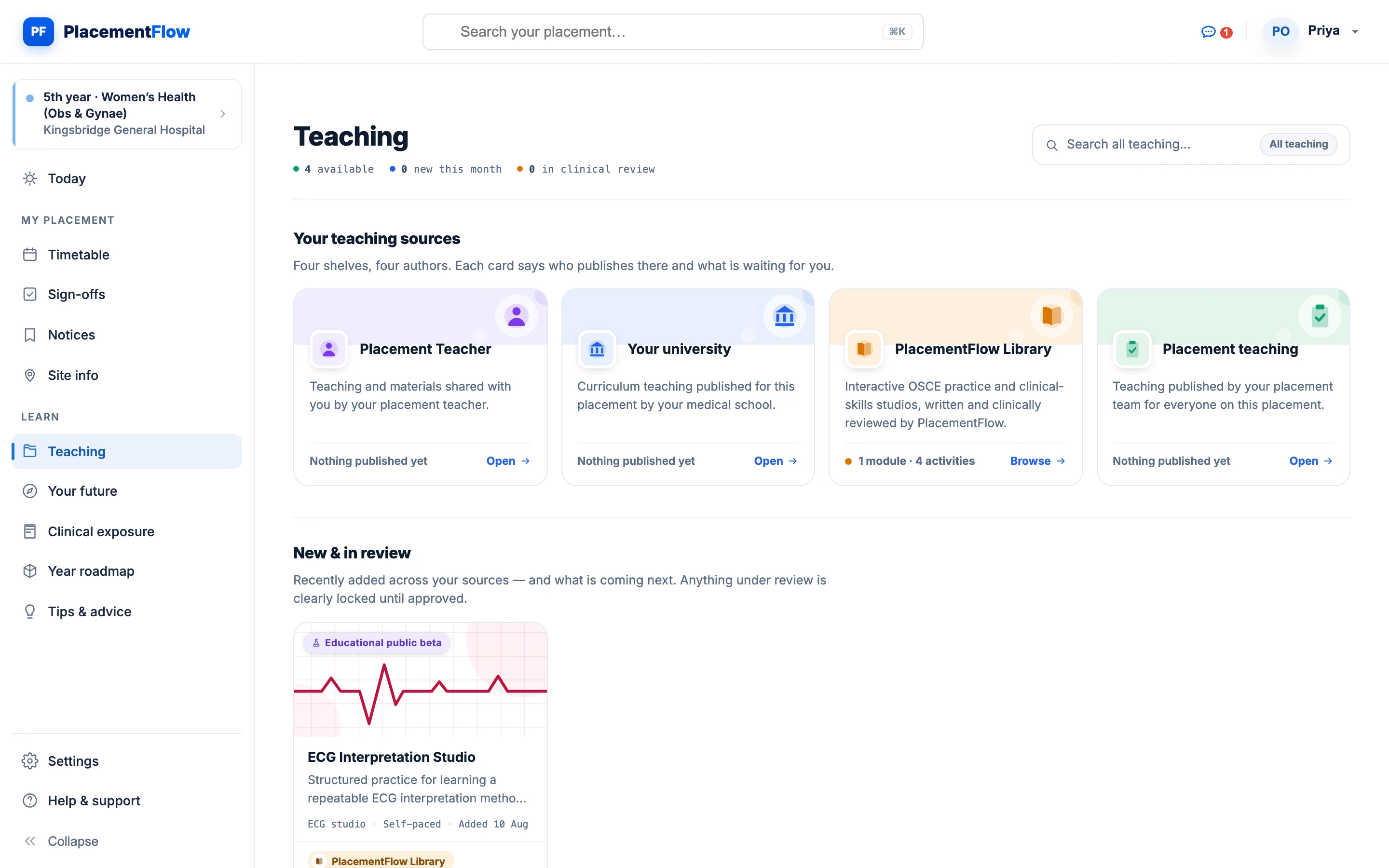
In the app, Teaching gathers everything in one place and says who published it: your placement teacher, your university, the PlacementFlow library, and the placement itself. Anything still under review is visibly locked until it is approved.
- Placement teacher — material shared with you directly.
- Your university — curriculum teaching for this placement.
- PlacementFlow library — the studios on this page, as they are released.
- Placement teaching — published by the placement team for everyone on the block.
The studios
What is being built, and how each one will work.
These are design intentions, written down so you can see where the tools are going. None of them is available yet. Each opens to every student when it is released, after clinical review.
Teaching Studios In development
Short, clinically reviewed studio lessons on the conditions you meet on the ward. Each lesson is for one thing — a presentation, a decision, a finding — so that what you read on the ward matches what you saw in the studio ten minutes earlier.
Teaching Studios are being built to the model ECG Studio already runs on: small lessons, one idea at a time, and nothing marked complete until the server records that you have done it. There is no self-ticked checklist. Progress is what the studio can show you did, not what you said you did.
- Conditions, not chapters
- Lessons are organised around what presents on the ward, so a block's common conditions come first.
- Clinically reviewed before release
- A lesson opens to students only once its content has been through clinical review. Draft lessons stay out of sight.
- Server-recorded completion
- Finishing a lesson is recorded by the server when you have actually done it, and shown back on your learning path.
- Open to every student
- Released studios are not tied to a university connection. A free account is enough once a studio is live.
Clinical Examination In development
System-by-system examination technique: the order, the hands, and what each step is actually for. It is written for the moment before you approach the bed, not for the night before an exam.
Each system will pair the technique with what to look for and how a finding is recorded, so that the words you use in a presentation are the words a clinician expects to hear. It is being built as a studio, with the same server-recorded progress as the rest.
- Technique, system by system
- Cardiovascular, respiratory, abdominal, neurological and the rest, each as a short sequence you can rehearse.
- What to look for
- The findings each step is designed to elicit, and what a normal result looks like so the abnormal one stands out.
- How findings are recorded
- The phrasing and structure used to document and present an examination, so your write-up reads as a clinician's would.
- Linked to the bedside
- Designed to sit next to the placement record, so a Mini-CEX on a system can follow the lesson on it.
Consultation and History In development
Structured history taking and the consultation models behind it. The aim is a history you can take in the same order every time, so the structure carries you when the patient's story does not.
Lessons will work through a presenting complaint, the questions that matter for it, and how to present the history back in a form a ward round can use. Consultation sets are drafted and are pending clinical review before any of them open.
- Structured history taking
- Presenting complaint, history of it, and the systems, drugs, social and family context that change what you do next.
- Consultation models
- The common frameworks for opening, exploring and closing a consultation, and when each one earns its place.
- Presenting back
- Turning ten minutes at the bedside into a one-minute summary with a differential and a plan.
- Practice sets
- Worked consultations to rehearse against, released one set at a time as each passes review.
Specialty teaching In development
Specialty-specific teaching aligned to the block you are on. When you rotate into paediatrics, the studio shows paediatrics; when you move to psychiatry, it moves with you. Nothing generic sits between you and the specialty you are in this week.
It is being built so that a block's teaching, its common presentations and its examination and history studios line up as one set, rather than as separate places to look. Where your university publishes teaching for a placement, that stays with the placement; this is the studio content beside it.
- Aligned to your block
- The specialty you are rotating through comes first; everything else is one step away.
- The presentations you will meet
- Each specialty's common and important presentations, taught in the same short-lesson format.
- Specialty examination and history
- The developmental, mental-state and other specialty-specific assessments, connected to the general studios.
- Released specialty by specialty
- Each specialty opens on its own, after its own clinical review, rather than waiting for all of them.
Exam and OSCE preparation In development
Stations, marking-scheme-aware practice and timed runs. An OSCE rewards a specific, repeatable performance, and the studio is being built to rehearse exactly that — what is being marked, in the time you will actually have.
It will draw on the examination and history studios for its content, so a station is a timed application of something you have already learned rather than a new thing to memorise. Runs will be recorded server-side like every other studio.
- Stations
- Examination, history, communication and procedure stations in the format you will meet on the day.
- Marking-scheme-aware practice
- Practice that makes clear what a marker is looking for at each step, so you rehearse the marks and not just the motions.
- Timed runs
- Run a station against the clock, then see where the time went.
- Built on the studios
- Stations reuse the examination and history content, so practice and preparation stay consistent.
Specialty pathways In development
What each specialty involves, what to log while you are on the block, and who to talk to. A block is short, and the chance to see the specialty from the inside is easy to miss if you do not know what to ask for on the first day.
Pathways are being built to sit beside the placement record, so the experiences worth logging on a block are listed while you are there, and the sign-offs you request can follow them. The pathway content is drafted and is not yet released.
- What the specialty involves
- The shape of the work, the training route after F2, and what the day looks like at each stage.
- What to log while you are there
- The procedures, presentations and assessments worth capturing on this block, before it ends.
- Who to talk to
- The roles on the team worth a conversation, and the questions worth asking them.
- Beside your record
- Designed so that a pathway's suggested experiences can become sign-off requests in the same place.
Finals and assessment guidance In development
What is assessed, how it is assessed, and how to plan revision around placements rather than in spite of them. Finals arrive while you are still on the ward, and the guidance is being written for that reality.
It will lay out the assessment types a final year typically carries, what each one is looking for, and a way to plan revision across blocks so the specialty you are in is the one you are revising. It is guidance, and it is not a substitute for your own school's published assessment rules.
- What is assessed
- The knowledge, skills and behaviours a final-year assessment examines, in plain terms.
- How it is assessed
- Written papers, OSCEs and workplace-based assessments, and how each one is scored.
- Revision around placements
- A way to line revision up with the blocks you are on, so ward time and revision time pull in the same direction.
- Your school's rules come first
- The guidance is general. Your university's own assessment regulations always govern.
A free account shows what's available for you today.
Log in to see which studios are open on your account. Each one appears as it is released, and the placement record switches on when your university joins.
Studios open in stages, after clinical review.